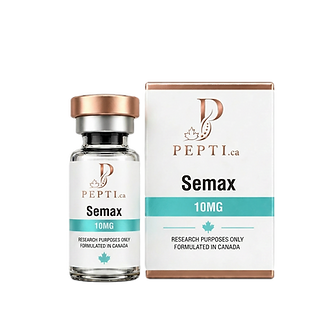
Product Description & Research Overview
Semax is a synthetic heptapeptide derived from adrenocorticotropic hormone (ACTH) fragment 4–10 that has been extensively researched for its nootropic, neuroprotective, and neurorestorative properties. Originally developed in Russia for stroke recovery, Semax has since become one of the most studied cognitive peptides for supporting memory, focus, learning, and overall brain function.
Research suggests Semax increases brain-derived neurotrophic factor (BDNF) and nerve growth factor (NGF) while modulating dopaminergic and serotonergic neurotransmitter systems involved in cognition, mood, and motivation. Unlike many cognitive compounds, it crosses into the central nervous system through direct transport via the olfactory epithelium and trigeminal nerves when administered intranasally, allowing rapid brain penetration.
Originally developed for neurological recovery, Semax continues to be investigated for applications involving stroke rehabilitation, traumatic brain injury, cognitive enhancement, neurodegenerative disorders, learning capacity, and healthy aging. Functional MRI (fMRI) studies have demonstrated increased default mode network activity, while clinical research has reported improvements in cognitive performance, attention, and recovery following neurological injury.
Semax remains one of the most extensively researched neuropeptides in Russian medical literature and is recognized for its favorable safety profile and broad neuroprotective potential.
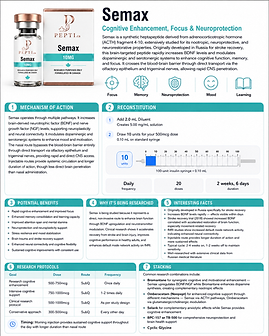
Research suggests Semax supports brain function through several complementary mechanisms:
Reconstitution (10 mg Vial)
Step 1
Add 2.0 mL diluent.
Creates a 5 mg/mL solution.
Step 2
Draw 10 units for a 500 mcg research dose.
Timing: Morning administration is commonly preferred for sustained cognitive support throughout the day.
Quick Reference
Vial Size: 10 mg
Route: Research injection (SubQ) or intranasal research
Frequency: Daily (most common research protocol)
Approximate Doses: 20
Approximate Vial Duration: 2 weeks, 6 days
Disclaimer
For research use only. Not for human consumption.
This information is provided for educational and laboratory research purposes only and is not intended as medical advice. These statements have not been evaluated by Health Canada or the U.S. Food and Drug Administration (FDA).
Research suggests Semax supports brain function through several complementary mechanisms:
Reconstitution (10 mg Vial)
Step 1
Add 2.0 mL diluent.
Creates a 5 mg/mL solution.
Step 2
Draw 10 units for a 500 mcg research dose.
Timing: Morning administration is commonly preferred for sustained cognitive support throughout the day.
Quick Reference
Vial Size: 10 mg
Route: Research injection (SubQ) or intranasal research
Frequency: Daily (most common research protocol)
Approximate Doses: 20
Approximate Vial Duration: 2 weeks, 6 days
Research suggests early improvements in focus, attention, and mental clarity may begin to appear.
Studies report improvements in learning capacity, memory consolidation, mood, and overall cognitive performance.
Continued use in research settings has been associated with sustained cognitive enhancement, improved neuroplasticity, and ongoing neuroprotective support.
Research suggests early improvements in focus, attention, and mental clarity may begin to appear.
Studies report improvements in learning capacity, memory consolidation, mood, and overall cognitive performance.
Continued use in research settings has been associated with sustained cognitive enhancement, improved neuroplasticity, and ongoing neuroprotective support.
Research suggests Semax supports brain function through several complementary mechanisms:
Reconstitution (10 mg Vial)
Step 1
Add 2.0 mL diluent.
Creates a 5 mg/mL solution.
Step 2
Draw 10 units for a 500 mcg research dose.
Timing: Morning administration is commonly preferred for sustained cognitive support throughout the day.
Quick Reference
Vial Size: 10 mg
Route: Research injection (SubQ) or intranasal research
Frequency: Daily (most common research protocol)
Approximate Doses: 20
Approximate Vial Duration: 2 weeks, 6 days
Research suggests early improvements in focus, attention, and mental clarity may begin to appear.
Studies report improvements in learning capacity, memory consolidation, mood, and overall cognitive performance.
Continued use in research settings has been associated with sustained cognitive enhancement, improved neuroplasticity, and ongoing neuroprotective support.