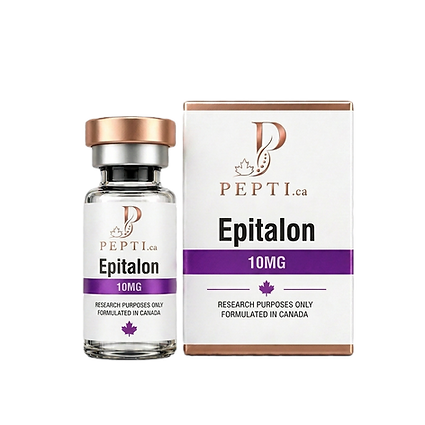
Product Description & Research Overview
Epitalon is a synthetic tetrapeptide (Ala-Glu-Asp-Gly) originally developed from Epithalamin, a naturally occurring peptide produced by the pineal gland. It has been extensively researched for more than three decades for its potential role in healthy aging, cellular regeneration, and longevity.
Much of the interest surrounding Epitalon stems from its ability to activate telomerase—the enzyme responsible for maintaining telomeres, the protective DNA caps that naturally shorten as cells divide. By supporting telomere maintenance, researchers believe Epitalon may help preserve normal cellular function and promote healthy aging at the cellular level, addressing one of the fundamental biological processes associated with aging rather than simply managing its symptoms.
In addition to its effects on telomeres, Epitalon has been investigated for its ability to regulate melatonin production, support circadian rhythm, improve sleep quality, enhance immune function, promote neuroprotection, and influence gene expression through epigenetic pathways. Animal and laboratory studies suggest these combined actions may contribute to improved longevity, tissue repair, skin health, and overall physiological resilience.
Unlike traditional antioxidants that primarily reduce oxidative stress, Epitalon is being researched for its potential to enhance the body’s own cellular maintenance and repair mechanisms. This broader approach has made it one of the most extensively studied geroprotective (healthy aging) peptides.
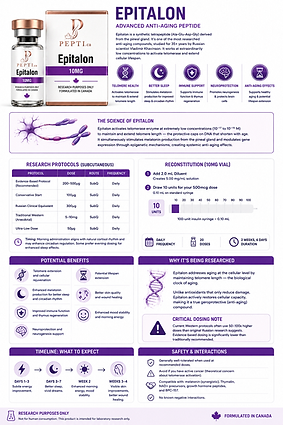
Research suggests Epitalon may support healthy aging through several complementary mechanisms:
Timing: Morning administration aligns with the body’s natural cortisol rhythm and may support circadian regulation. Some researchers prefer evening dosing when sleep enhancement is the primary objective.
Reconstitution (10 mg Vial)
Step 1
Add 2.0 mL diluent.
Creates a 5.0 mg/mL solution.
Step 2
Draw 10 units for a 500 mcg dose.
Quick Reference
Frequency: Daily
Doses per vial: 20 doses (at 500 mcg)
Approximate vial duration: Approximately 2 weeks and 6 days
Research Notes
Why It’s Being Researched
Epitalon is being investigated for its potential to address aging at the cellular level rather than simply reducing the symptoms associated with aging. By supporting telomere maintenance, regulating melatonin production, and influencing cellular gene expression, researchers hope to better understand its role in preserving long-term cellular health, tissue function, and physiological resilience.
Unlike traditional antioxidants that primarily reduce oxidative stress, Epitalon is studied for its potential ability to improve the body’s intrinsic repair and maintenance systems, making it one of the most widely researched geroprotective peptides.
Safety & Interactions
Disclaimer
For research use only. Not for human consumption.
The dosing information provided is intended solely for laboratory and research purposes and is not medical advice. Always consult qualified professionals regarding research protocols.
These statements have not been evaluated by Health Canada or the U.S. Food and Drug Administration (FDA).
Research suggests Epitalon may support healthy aging through several complementary mechanisms:
Timing: Morning administration aligns with the body’s natural cortisol rhythm and may support circadian regulation. Some researchers prefer evening dosing when sleep enhancement is the primary objective.
Reconstitution (10 mg Vial)
Step 1
Add 2.0 mL diluent.
Creates a 5.0 mg/mL solution.
Step 2
Draw 10 units for a 500 mcg dose.
Quick Reference
Frequency: Daily
Doses per vial: 20 doses (at 500 mcg)
Approximate vial duration: Approximately 2 weeks and 6 days
Research Notes
Why It’s Being Researched
Epitalon is being investigated for its potential to address aging at the cellular level rather than simply reducing the symptoms associated with aging. By supporting telomere maintenance, regulating melatonin production, and influencing cellular gene expression, researchers hope to better understand its role in preserving long-term cellular health, tissue function, and physiological resilience.
Unlike traditional antioxidants that primarily reduce oxidative stress, Epitalon is studied for its potential ability to improve the body’s intrinsic repair and maintenance systems, making it one of the most widely researched geroprotective peptides.
Initial Adaptation
Sleep Improvements
Enhanced Recovery
Longer-Term Benefits
Initial Adaptation
Sleep Improvements
Enhanced Recovery
Longer-Term Benefits
Research suggests Epitalon may support healthy aging through several complementary mechanisms:
Timing: Morning administration aligns with the body's natural cortisol rhythm and may support circadian regulation. Some researchers prefer evening dosing when sleep enhancement is the primary objective.
Reconstitution (10 mg Vial)
Step 1
Add 2.0 mL diluent.
Creates a 5.0 mg/mL solution.
Step 2
Draw 10 units for a 500 mcg dose.
Quick Reference
Frequency: Daily
Doses per vial: 20 doses (at 500 mcg)
Approximate vial duration: Approximately 2 weeks and 6 days
Research Notes
Why It's Being Researched
Epitalon is being investigated for its potential to address aging at the cellular level rather than simply reducing the symptoms associated with aging. By supporting telomere maintenance, regulating melatonin production, and influencing cellular gene expression, researchers hope to better understand its role in preserving long-term cellular health, tissue function, and physiological resilience.
Unlike traditional antioxidants that primarily reduce oxidative stress, Epitalon is studied for its potential ability to improve the body's intrinsic repair and maintenance systems, making it one of the most widely researched geroprotective peptides.
Initial Adaptation
Sleep Improvements
Enhanced Recovery
Longer-Term Benefits